the institutional stack
Five systems, five figures a seat
The chain from data to execution exists today — split across disconnected terminals, models, spreadsheets and systems, priced for institutions, and stitched together by hand at every joint.
Four products on one platform: research that screens the whole market in plain English and cites its answer, a seventeen-desk council that argues every call in public and seals the transcript, autopilot on a paper book, and a proof layer that lets you re-derive any number in the browser.
Watch it run · 3 min 5 sThe depth it is measured against is the platforms that set the institutional standard — Bloomberg, BlackRock Aladdin and Murex — with one difference designed in from the first line: every number carries its own proof.
The ambition is plain: build the infrastructure that turns market data into trusted intelligence — and trusted intelligence into action — on a platform designed to evolve into full-stack trading.
The last link is deliberately bounded: trading is paper today, by design, and live execution ships only when the public record and the required registrations earn it.
The chain from data to execution exists today — split across disconnected terminals, models, spreadsheets and systems, priced for institutions, and stitched together by hand at every joint.
A quote, a chart and a headline end exactly where sizing, risk, attribution and compliance begin — the half of the job that decides whether the idea was any good.
AI that asserts a call without showing its data, its dissent and its graded record cannot be trusted with money.
Live boards across stocks, ETFs, indices, futures and crypto — every figure stamped with the vintage of its own print, or reading unavailable. Open →
The whole covered universe screened in plain English, with fundamentals, valuation and a DCF whose every input is shown. Open →
Ten technical models plus a learned weighting layer, each call graded on realized outcomes. Open →
The paper book marked to the live price — holdings, target weights, factor decomposition and attribution on one canonical position store.
Component VaR and expected shortfall, correlated stress and pre-trade what-if on the same book.
A hierarchical limit tree, mandate rules, four-eyes approval and a tamper-evident audit trail.
A seventeen-desk council argues every call in public, with a red team, and seals the transcript with its dissent. Open →
Autopilot works the full order lifecycle against the paper book — paper by design, with a kill switch, every order audit-appended.
Under all eight stages sits the proof layer: every number carries its own proof — its source, its vintage, and a seal you can re-derive in the browser.
The portal free with no login, and the full workspace — the same screens the desks run, not a lesser copy — on one seat.
Open the portal →The chart, the chain, the signal engine and the paper order lifecycle on one screen, every figure stamped with its vintage.
Open the technical read →The research depth and the risk and control machinery of a large desk, in a browser — no installation, no data contract of your own.
Ask the screener →Factor decomposition, attribution, mandate rules and a re-derivable audit trail on the same book the research runs on.
Read the graded record →Verdicts auditable line by line — the debate, the dissent, the seal — and desk and multi-seat arrangements: write to the desk.
Write to the desk →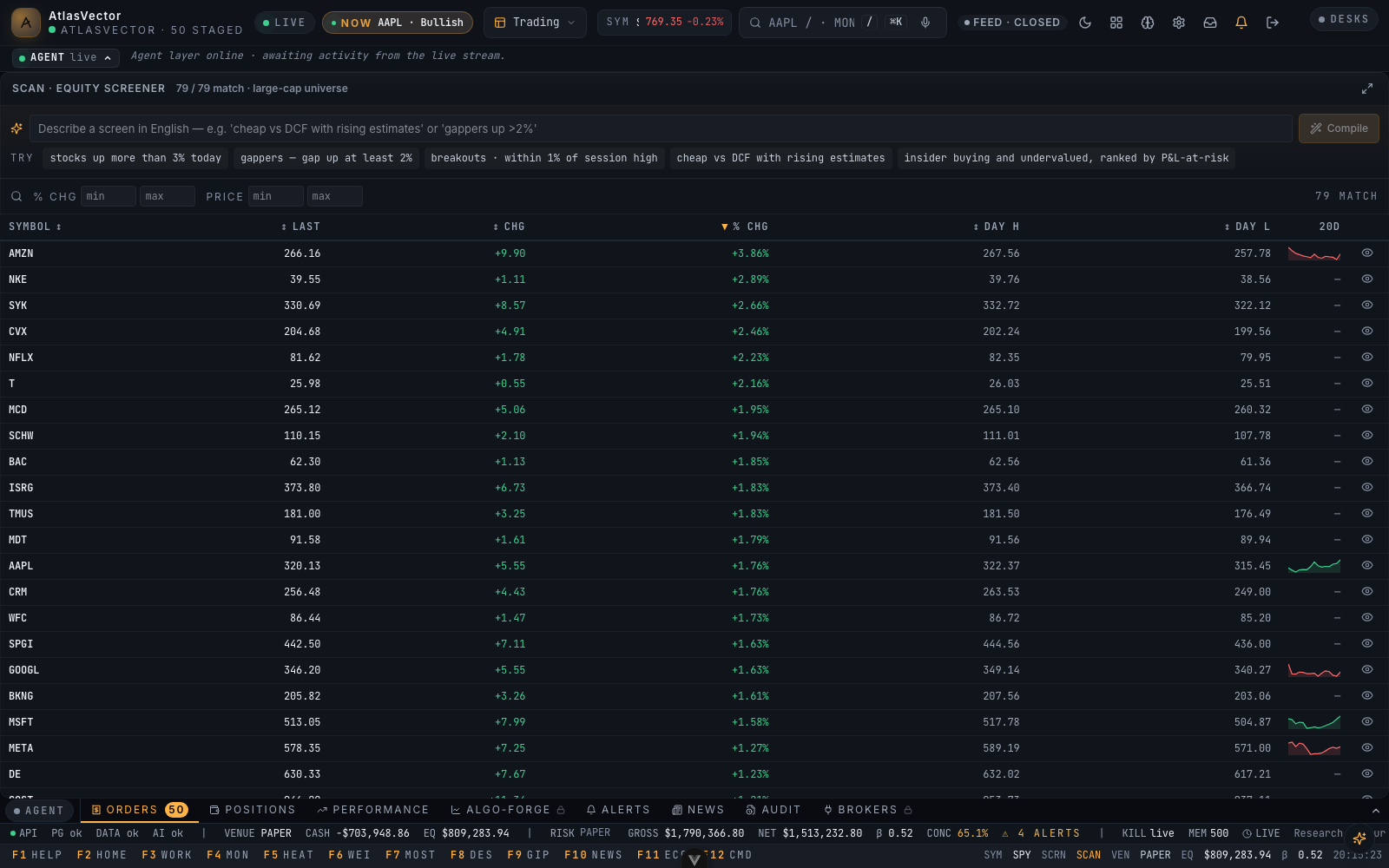
Screen the whole market in plain English and get a cited answer you can re-run.
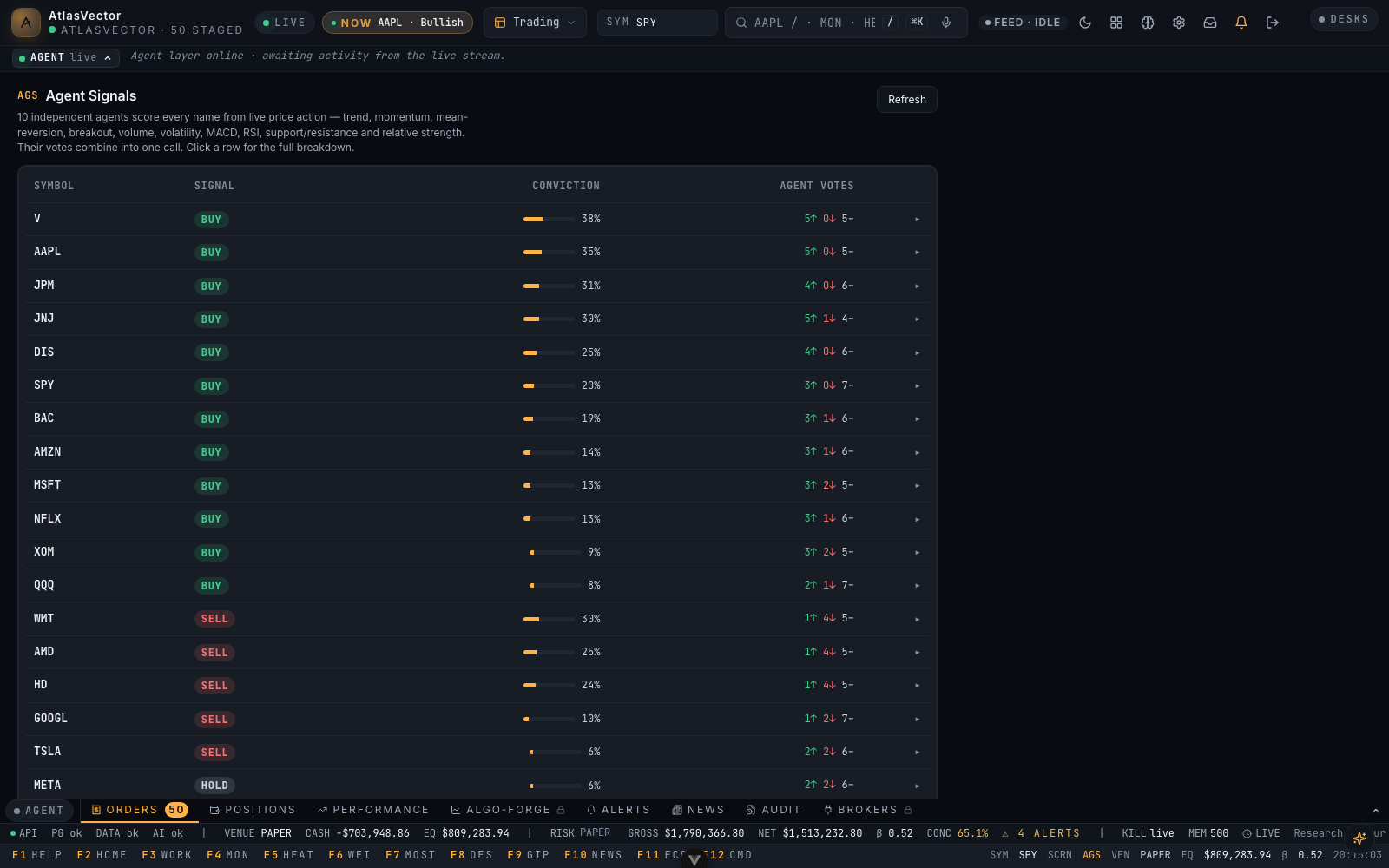
Every call is argued by a council in public, sealed with its dissent, and worked by autopilot on a paper book.
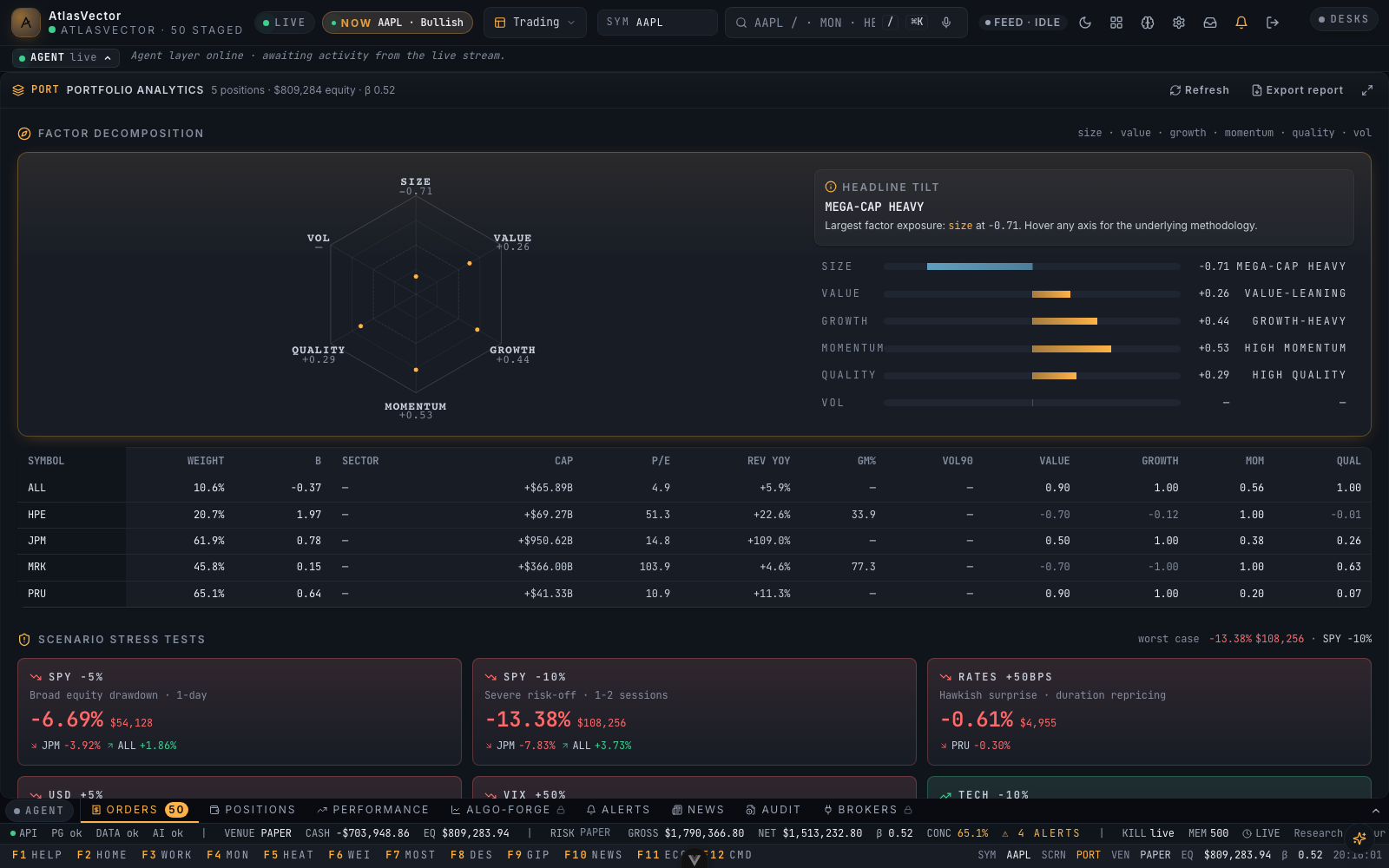
See the book’s exposure, stress it under named scenarios, and let a limit block a trade before it happens.
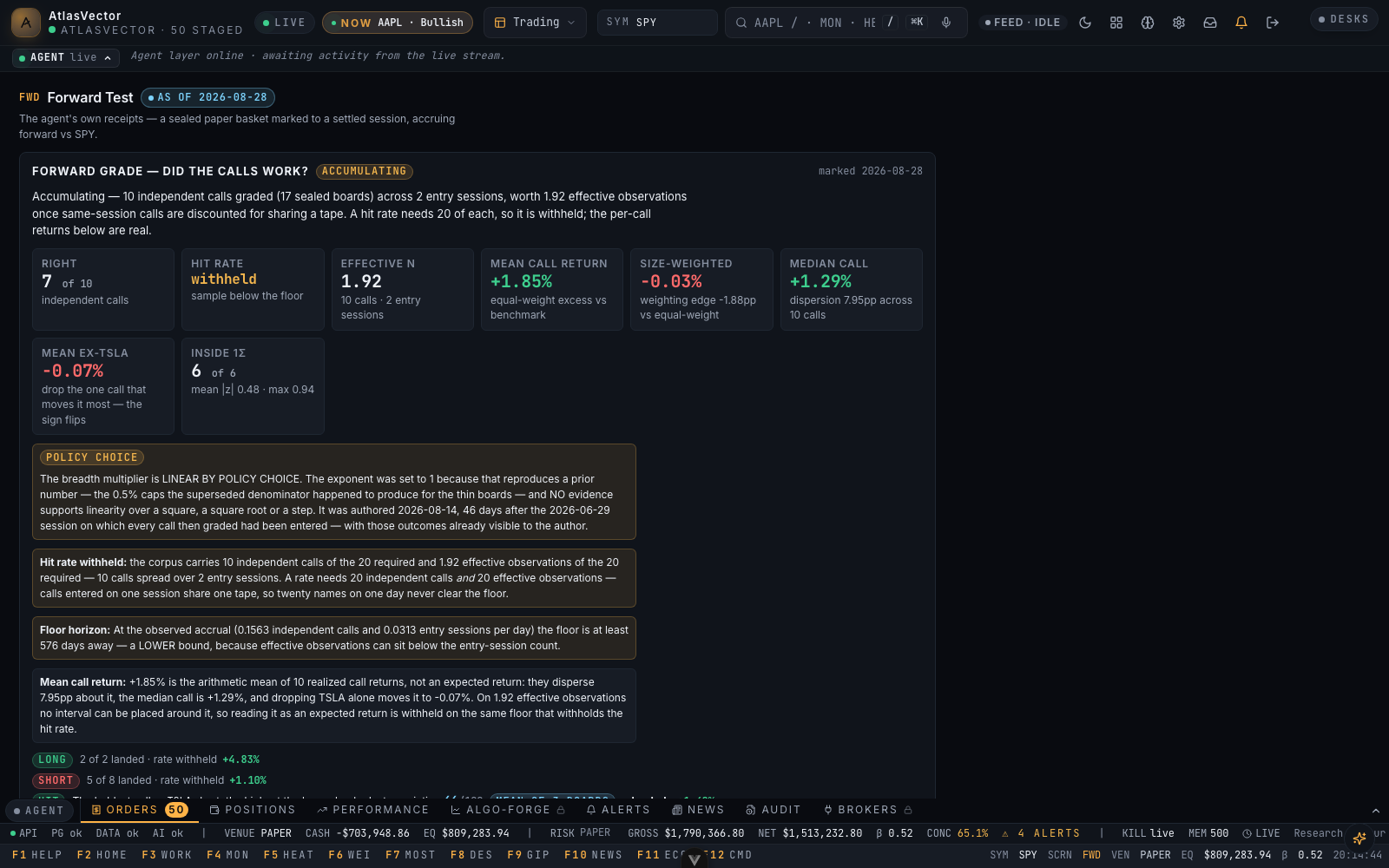
Every figure states its source and vintage, every verdict is sealed to a chain, and the record marks the calls to price.
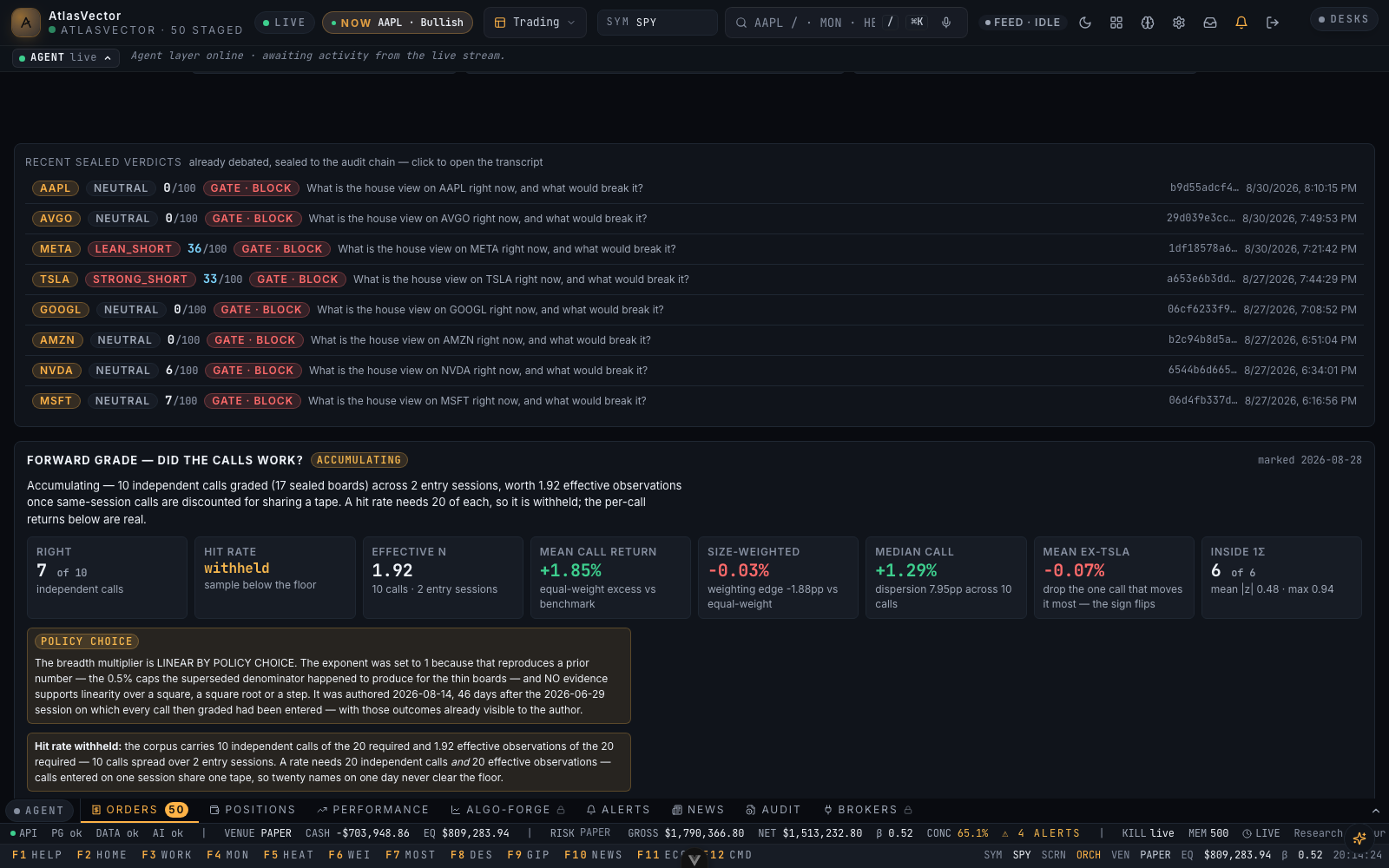
ACCUMULATINGAccumulating — 15 independent calls graded (23 sealed boards) across 4 entry sessions, worth 3.57 effective observations once same-session calls are discounted for sharing a tape. A hit rate needs 20 of each, so it is withheld; the per-call returns below are real.
At the observed accrual (0.7895 independent calls and 0.2105 entry sessions per day) the floor is at least 76 days away — a LOWER bound, because effective observations can sit below the entry-session count.
Effective observations can never exceed entry sessions, so clearing the 20-effective floor requires at least 20 distinct entry sessions. Any projection here is therefore a LOWER bound on the time to a publishable rate.
Does conviction track outcome? Not yet measurable — the corpus carries 15 independent calls of the 20 required and 3.57 effective observations of the 20 required — 15 calls spread over 4 entry sessions; every call so far landed in conviction buckets 0-24, 25-49 — monotonicity is UNMEASURED, which is not the same as absent.
first close printed strictly after the seal instant — never a price that existed when the board was sealed
the latest session BOTH the name and the benchmark have finished — finished meaning the tape has stopped printing for it (20:00 New York), not merely that the bell has rung, because a day print keeps absorbing late trades after the close. A session still trading is never marked, so two reads inside one session return the same figures: a close does not move
excess = name return − benchmark return over the same sessions; a short is right when the excess is negative
rates are computed over independent calls, keyed by (name, entry session)
the abstention ledger is DISJOINT from the call ledger on that same key — a neutral board on a name other boards called that session belongs to the calls, and is listed as also-called rather than counted twice
abstained and called names are compared only on ONE basis (mean ABSOLUTE excess). A magnitude is never set against a signed return and never called a cost: that would assert a direction accuracy this record withholds
a rate needs 20 independent calls AND 20 effective observations — calls entered on one session share one tape and are discounted for it, so twenty names on one day never clear the floor
every published rate carries a 95% Wilson score interval computed on the effective observation count; computing it on the nominal count would narrow the band by exactly the design effect
a rate is printed to the decimals its sample supports (a 20-observation rate resolves to 5 percentage points, so it prints to whole percent) — hits and n always ship, so the exact ratio is recoverable
conviction buckets are cut on the figure RE-DERIVED from each row's own sealed desk stances under the rule the house stands behind today, never on a superseded sealed figure; the sealed figure ships beside it
the weighted return sizes each call through the capital gate — conviction-band cap x panel participation — and the equal-weight figure it is set against is recomputed over the SAME sized calls, never over a larger set
every call carries the realized sigma of its own daily excess series over its own window; a return inside one sigma is a direction that landed, and is reported as such rather than as a magnitude
the mean call return carries the same discipline as a rate: its cross-sectional dispersion, its median and the mean without the single call that moves it most all ship beside it, and reading it as an EXPECTED return is withheld until the effective observation count clears the same 20 floor the hit rate clears
a session move above 1.8x or below 0.55x inside the window excludes the name — unadjusted bars would read a split as a return
23 sealed boards graded · 15 independent calls · newest seal 2026-09-14 · marked through 2026-09-11
Deep on the breadth of real-time data and a professional desk’s tooling, priced per seat for professionals.
hereThe boards, the screens and the risk math in a browser — and every verdict with its transcript, its dissent and its seal.
Deep on charts, drawing tools and community ideas.
hereThe chart, then the ten-model call on it, the debate behind that call, and the record the call is graded against.
Deep on quotes, headlines and simple screens at no cost.
hereThe portal here stays free too — and each figure carries its source, its vintage and a way to re-derive it.
Bloomberg, BlackRock Aladdin and Murex are their owners’ marks, named as the standard we measure against; the cards keep to archetypes, and each describes publicly-documented positioning only. The full capability comparison is in the inventory below.
Execution is a single paper book marked to the live price, and every order surface prints the venue as paper. No customer money is held or managed, and there is no live order routing. Execution through licensed brokers is in the pipeline, and ships when the published record earns it.
Read the graded record →Each figure carries the vintage of the print it came from. A figure that cannot be computed reads unavailable rather than zero; a surface that still runs on a synthetic display grid says so on the surface; and the provenance board lists every feed’s state.
See the provenance board →AtlasVector publishes calls, the transcripts behind them and a graded record of how they fared. It is research: the decision, and the risk in it, stay yours.
Read a sealed debate →Open any ticker in the portal for the cited thesis and the desk’s standing call — or take a seat and open the whole workspace.
Leave an address and we'll write when the platform ships something worth your time. What is sent: the address, which page you left it on, and the anonymous per-tab id the site counts page views with — nothing else. The request is stored with your connection's address and browser until it is served (we have written back, or the address has opened a seat), then the scheduled cleanup deletes the record; deletable earlier on request per the privacy policy.
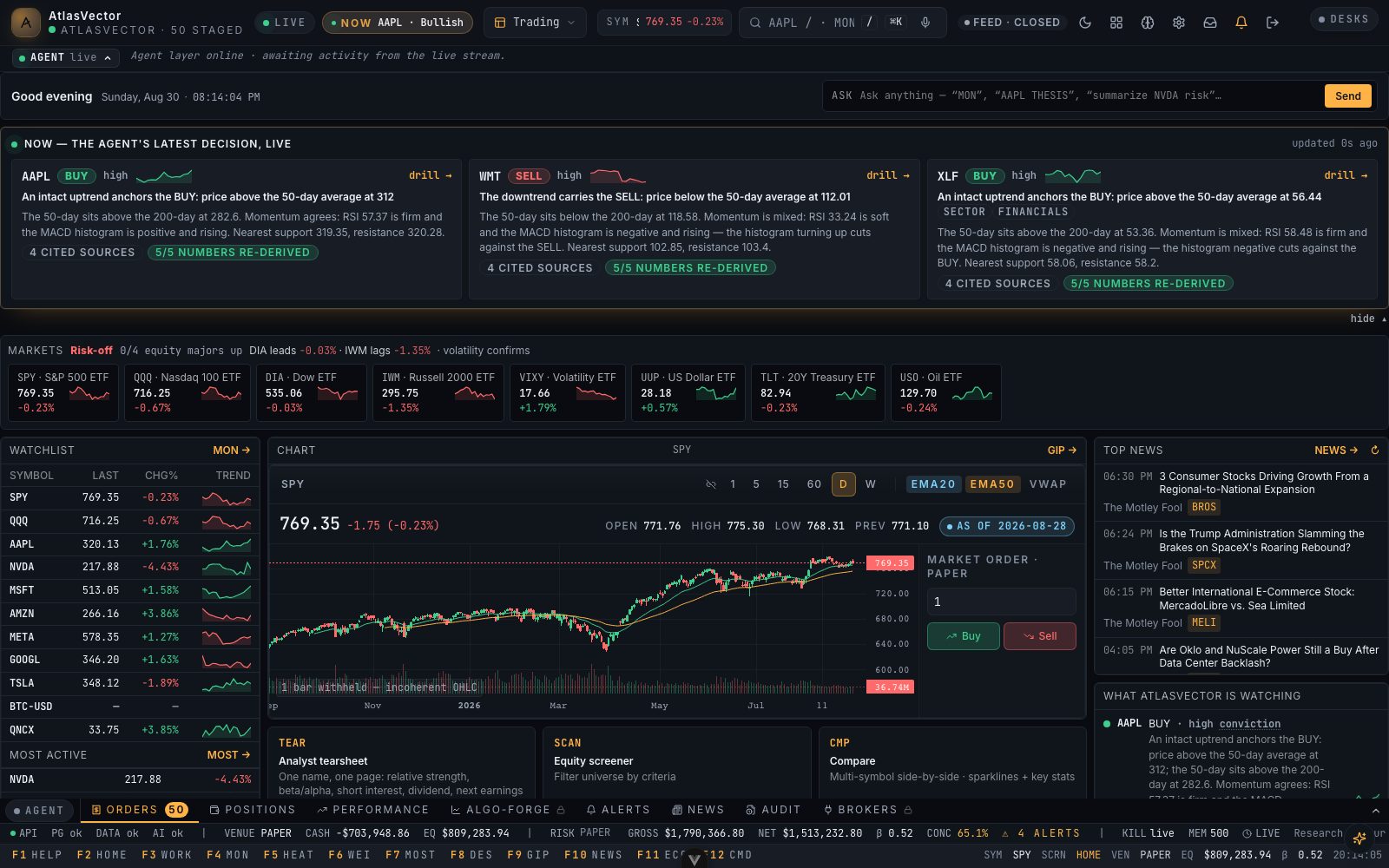
Read the regime, the sector theses and the desk’s most recent decisions on one board.
Open →INDICESTrack the US index levels and the volatility gauge, each stamped with the vintage of its own print.
Open →FUTURESRead front-month equity, rate, energy and metal contracts with their settlement basis shown.
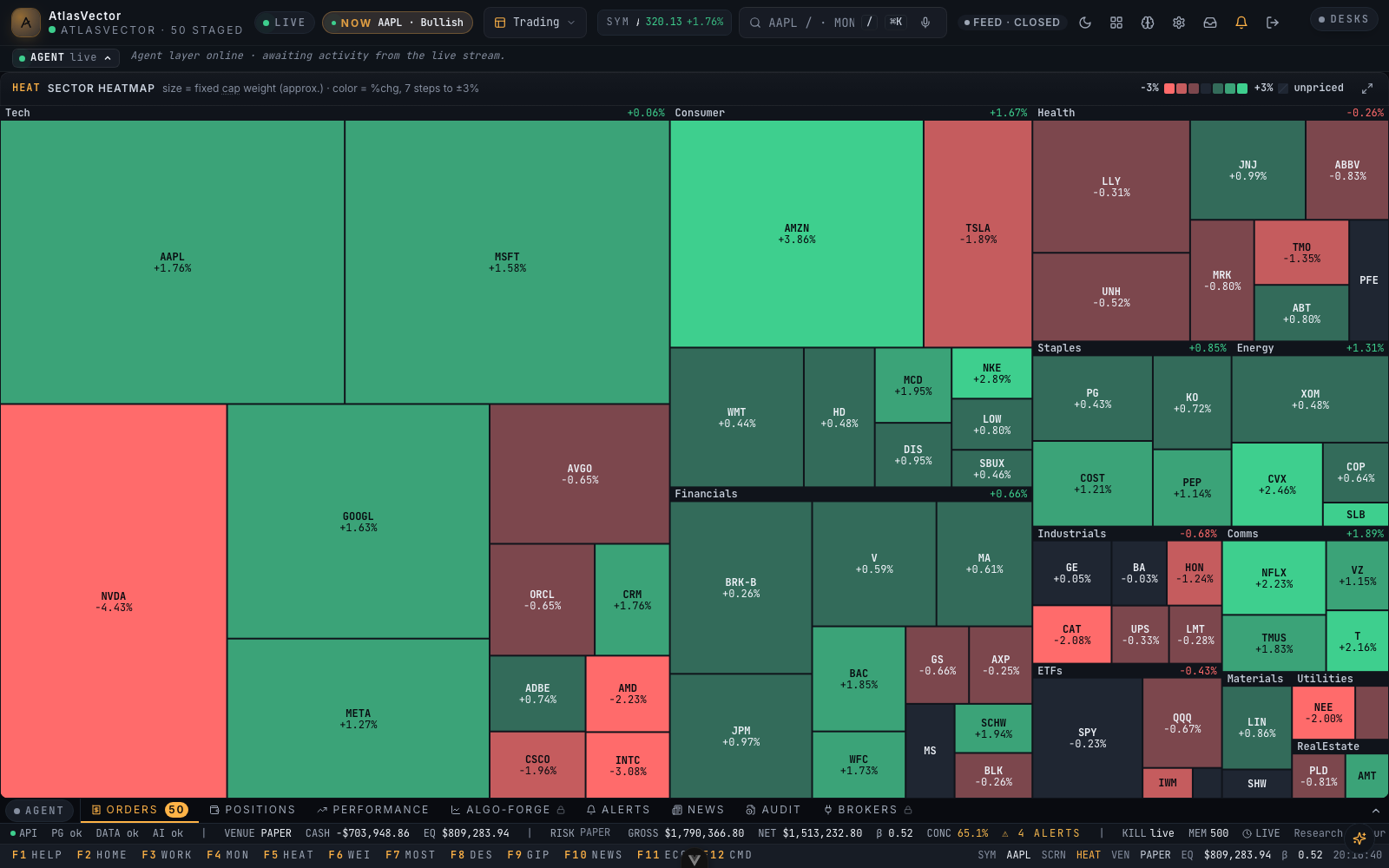
Open →SECTORSee which sectors are leading, which are lagging, and the relative strength underneath the move.
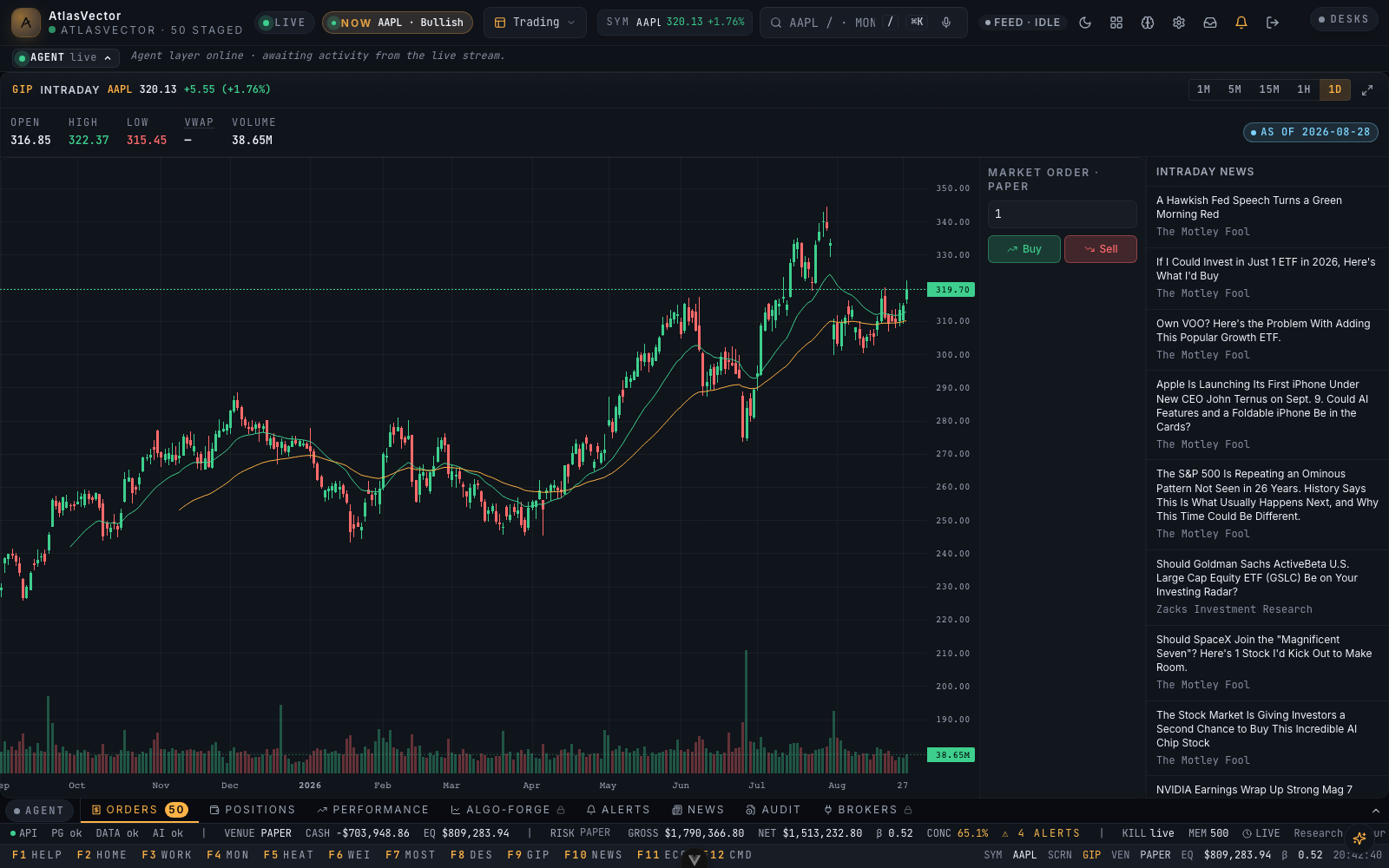
Open →CHARTCandlesticks, Bollinger bands and the RSI/MACD pair, with the computed levels a desk starts from.
Open →OPTIONSWork a real chain — strikes, implied volatility and greeks — and read the strategy the shape implies. The front expiry opens to anyone; every expiry, on the seat.
Open →Ask for “oversold liquid names above their 200-day average” and the screen is compiled and run in front of you; keeping it under your name and re-running it unattended with alerts are the seat’s.
Open →SCREENFilter the covered universe on price, trend, return and liquidity, then sort the result column by column.
Open →STOCKOpen any ticker for the cited thesis, the levels, the ownership of every figure and the desk’s standing call.
Open →VERSUSPut a pair against each other on relative strength, beta and alpha, valuation and the spread between them.
Open →MACRORead rates, curves, breadth and correlation, and the regime the desk is trading in.
Open →GRAPHWalk the links between issuers, filings, events and the desks that cited them.
Open →Rank the universe on ten technical models plus a learned weighting layer, graded on realized outcomes.
Open →DEBATERead a full multi-desk debate — the argument, the red-team pass, the self-falsification and the audit seal.
Open →DECISIONSFollow each BUY / SELL / HOLD flip in order, with the one-line reason recorded at the time.
Open →BOOKSee which names the desks currently cover, at what conviction, and where they disagree.
Open →RECORDSee every published call marked to price, with the qualifiers that say what the sample can and cannot support.
Open →PROVENANCECheck, per feed, what is live, what is delayed and what currently reads unavailable.
Open →
A question fans out across specialist desks; they run their tools concurrently, challenge the thesis through RED-TEAM, and converge on a cited answer — every step written to a tamper-evident audit chain.
The extended review panel convenes up to eight desks from a seventeen-desk registry; the shipped public verdict panel is equity, risk, a sell-side MD and an adversarial red-team. A run finishes in seconds, with red-team review on every consolidated verdict.
Real-time feed where entitled — stocks, index/sector/commodity/rates ETFs and crypto spot; some cross-asset tiles are proxies. A real-time entitlement is not a promise that every figure is seconds old: outside a session, or where an instrument has not printed, the value is a close or settlement and the surface says so and dates it. Real, or labelled unavailable — never estimated in place.
Computed on the real paper book. The VaR-backtest verdict waits on the daily forecast clock filling 250 days, and the surface says how many it holds.
These govern the agent’s own proposal and paper-execution path — the control math is real (limits enforced pre/post-trade, self-approval rejected server-side).
One canonical position store. Brinson returns “unavailable” in prod until the benchmark/sector map is wired to a live feed; the factor section is live.
The arbitrage-free surface is fit from the real chain; a clearly-labelled synthetic display grid is used only when the free-tier feed can’t serve the chain. Chains on the live streaming feed are in the pipeline.
The learned model is off by default and changes nothing while off; it emits a calibrated probability mapped to a call with disclosed thresholds — never an invented number.
Computed from standardized real feeds where entitled; several forward / alt-data / model-audit surfaces are clearly labelled synthetic until live data lands.
Paper only — a single paper account; Autopilot executes automatically within it. Broker adapters reconcile positions read-only; there is no live order routing yet — live Autopilot execution via licensed brokers is in the pipeline below. Research — your decisions, your risk.
Reasoning and numbers you can re-derive and audit, rather than take on trust. Metrics degrade to “unavailable” rather than fabricate.
Scroll the table sideways to see all four columns →
| Area | AtlasVector | The market-data terminal | The enterprise risk platform | The sell-side trading system |
|---|---|---|---|---|
| Real-time multi-asset data | Real-time — stocks, ETFs, indices, futures, crypto; options analytics on real chains | The market standard | Yes | Yes |
| Risk analytics — VaR / ES, factor, stress | Built-in — component VaR/ES, factor model, correlated stress | Portfolio analytics suite | Core strength | Core strength |
| Compliance & controls | Hierarchical limits, four-eyes, mandate engine, kill-switch | Not publicly documented | Yes | Yes |
| Derivatives & options desk | Arbitrage-free vol surface, greeks ladders, P&L explain | Yes | Not publicly documented | Core strength |
| Performance attribution | Selection, timing and allocation decomposition, reconciled (factor/sector Brinson in the pipeline) | Portfolio analytics suite | Yes | Yes |
| Multi-agent glass-box reasoning | Specialist analyst desks debate every call — sealed & re-derivable | Not publicly documented | Not publicly documented | Not publicly documented |
| Transparent & auditable | A re-derivable audit seal on every verdict | Proprietary | Proprietary | Proprietary |
| Ask a question in your own words | Natural-language queries, cited answers | Not publicly documented | Not publicly documented | Not publicly documented |
| Who it is for | Retail & institutional — in a browser | Professionals | Institutions | Banks & institutions |
The incumbent columns are capability archetypes, not named products, and describe publicly-documented positioning only — a capability that is not publicly documented is marked as such, since we have not audited those products. Our own list price is published on the pricing page — card checkout is open there.
Market data across stocks, ETFs, indices, futures and crypto, the research and screening surfaces, the multi-desk debate with its sealed transcripts, and the published record of what the desks called. Every figure carries the vintage of the print it came from; a figure that cannot be computed reads as unavailable rather than as a zero.
See the provenance board →Execution is a single paper book in this phase, marked to the live price, and it says so on every order surface — the workspace status strip prints the venue as paper. No customer money is held or managed, and there is no live order routing. Real-money execution ships when the published record earns it.
Read the graded record →The workspace itself, on a paid seat: the full screen registry, saved layouts, watchlists and alerts, the order lifecycle on the paper book, portfolio risk, and the private research the desks run for one account. Sign-up ends in card checkout; the portal stays free without one.
Launch AtlasVector →ACCUMULATINGhit rate withheld — the corpus carries 15 independent calls of the 20 required and 3.57 effective observations of the 20 required — 15 calls spread over 4 entry sessions.
Depth follows the feeds we are entitled to; where a figure cannot be sourced, the surface reads unavailable rather than estimating in place.
Raw data breadth does not match a full institutional market-data terminal. What sits on top of it is multi-desk reasoning you can read line by line and an audit trail you can re-walk.
The same agents that run the paper book today, executing real orders on your behalf through licensed third-party brokers — flip Autopilot from paper to live, same signals, same audit trail. Ships only when the required registrations and regulatory approvals land, under its own terms and your express enrollment. Today every order is paper.
Research, verdict and execution under one roof: signal → debate → order as one auditable pipeline, through partner brokers first and, in time and subject to licensing, a brokerage of our own.
A formal SOC 2 program with independent attestation. The hash-chained audit trail ships today; the certification program is in build.
Full chains on the streaming real-time feed. Today options analytics are computed on real chains via the entitled feed, with any synthetic display grid clearly labelled.
Term structure, basis and full curves per product. Today the front-month board covers the major complexes on the Futures page, each row stamped with its own print vintage.